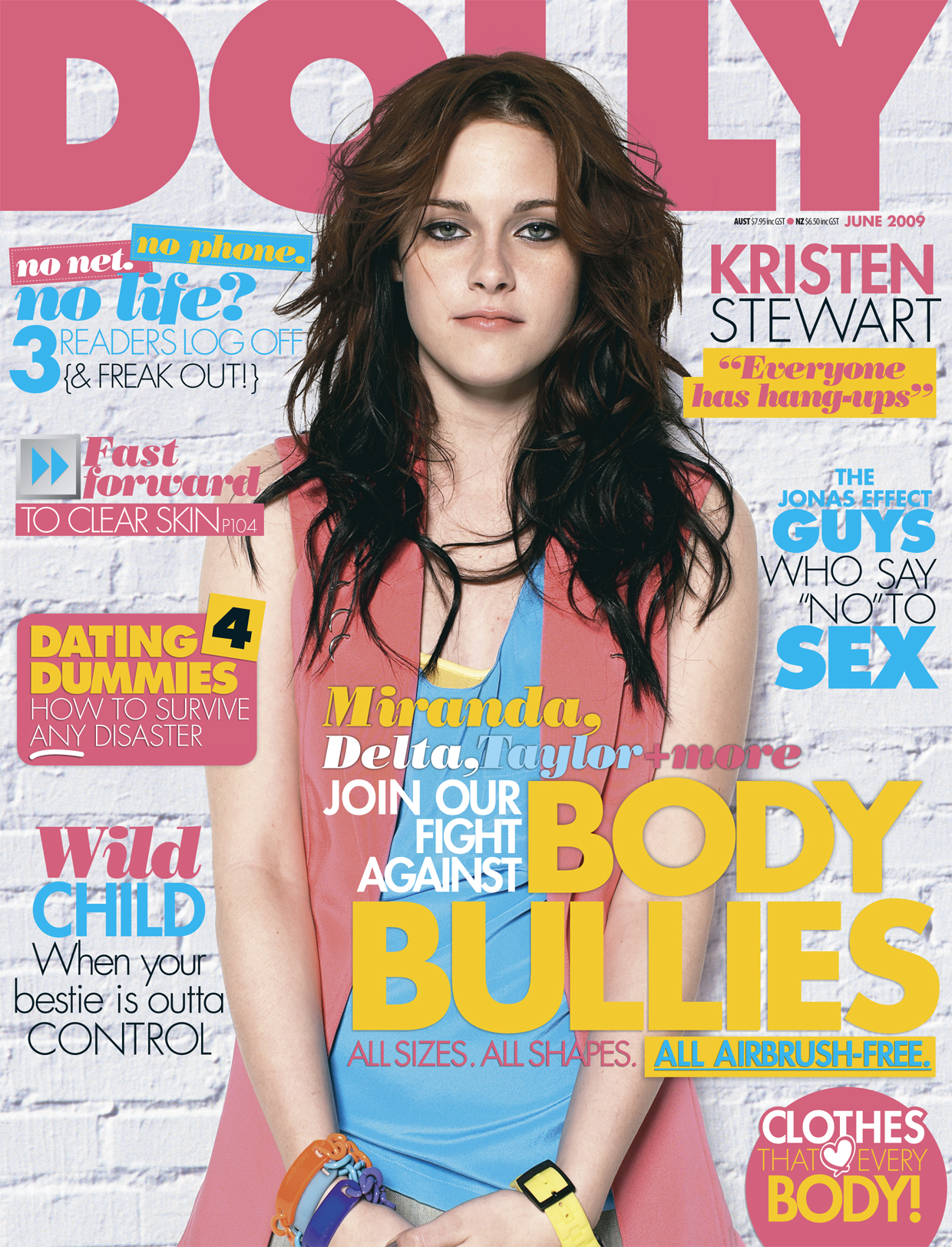
A teen magazine down under has just launched the "Heart Your Body" campaign, which includes an issue with non-airbrushed photos. Dolly editor Gemma Crisp appeared on Australia's Today show to discuss the campaign.
"Airbrushing in magazines is quite insidious, everyone does it...I'm really worried about girls looking at magazines and these so-called 'perfect' images." A survey conducted by Dolly revealed that four out of five of girls are unhappy with their bodies.
Of course not every image in the magazine, which hit newsstands May 13th, is free of retouching. The editor admits that they often get photos directly from publicists or photo agencies that have already been altered. And while Crisp discusses a series of before/after shots (including Jessica Alba in the Campari ad campaign), revealing how dramatically retouching can alter the shape of someone's body, she's reluctant to admit that Dolly has done any digital slim-downs in the past. She said most of their retouching has been limited to removing red-eye, bruises, and "patchy, fake tan." As part of this new campaign, which includes Kat Dennings and Taylor Swift, non-retouched images will be labeled throughout the magazine.
The campaign seems like a great idea, but they only showed one image from the magazine. It was difficult to see the bruise on actress Jessica Mauboy's arm or the red-eye that Crisp mentioned. And what about the cover? The "all airbrush-free" tagline refers to specific stars (not cover girl Kristen Stewart) and the article included with Today appearance says that "all the action starts on page 61," referring to "retouch-free zones." Did they leave Kristen Stewart alone? Because there is not a blemish or a bruise to be found, and the whites of her eyes are white as white can be.
When asked if this campaign would continue in future issues, Crisp responded: "Probably. Definitely."
Have you seen this New York Times video op-ed about retouching? It's pretty compelling stuff, especially because the filmmaker got some working retouchers to admit that they do face an ethical dilemma in drastically "perfecting" images. Would it be less of a dilemma if the practice of retouching was openly acknowledged by the magazines and advertisers as part of the creative process?
I attended a Dove self-esteem workshop for teens last night featuring the amazing Jess Weiner and Courtney Martin. They showed this video, which was developed by the UK eating disorders organization, beat. What I love about it (besides the cute British boy who gets a goth makeover) is that it addresses the many different ways fashion and beauty images are manipulated. Of course retouching is in the mix, but they also break down other tricks of the trade. Watch for a model's clothes being pinned and lighting changes that produce entirely different effects.
Keira Knightley has had her share of boob controversy. First there was the digitally enhanced King Arthur poster, followed by speculation over whether she really had enough up top to fill that hat she was holding in the recent Chanel ads. Now Keira is taking a stand, refusing any cleavage alterations on the publicity photos for her new film, "The Duchess."
"She has insisted that her figure stay in its natural state," an insider said. "She is proud of her body and doesn't want it altered."
We throw around the "unrealistic beauty ideals" phrase, and while it's true that Keira's body type is not realistic for most of the female population, it's her body and she deserves to feel good about herself--just as people of all shapes and sizes deserve to feel good about themselves, too. The ultimate goal is body diversity, isn't it? When an actress tries to make a point about self-acceptance by calling out the practice of retouching, it really doesn't help the cause to call her a "freak of nature" or tell her to "eat a cheeseburger." [Huffington Post]
Meet Christopher Bell. That's him in the before and after photos. In one of the most compelling scenes of his movie, Bigger, Stronger, Faster, Bell shows the audience just how easy it is to manufacture and market a dietary supplement in the United States. He orders the ingredients, mixes them up in his kitchen, pours them into capsules, and works with a photographer to create an ad.
"Look as sad and depressed as you can," says the photographer as he snaps the first photo. Then Bell gets waxed and Photoshopped. Suddenly, he's "shredded." No need for FDA approval. No restrictions on his completely manipulated advertisement. It's all 100% legal.
While Bigger, Stronger, Faster focuses primarily on steroid use in America, it is ultimately an exploration of our culture's confusing messages about being the best. Our bodies and our spending habits are certainly evidence of our desperation to be extraordinary. Women are on a quest for thinness and eternal youth. Men feel more and more pressure to have rock hard muscles and six-pack abs. Some of Bell's subjects are extreme examples (Gregg Valentino's enormous biceps are disturbing, to put it mildly), but this is no freak show. It's a film about how our supermodel, supercelebrity, and superathlete worship is making it increasingly difficult to accept--and be happy--with ourselves.
UPDATE: Embedding has been disabled, but follow this link to watch the spot.
This one gets me every time. Spread it around because this is what every girl needs to hear. Check out the other ads in this series, and give Girls Inc. some love while you're at it.
Yesterday Claire wrote about the New Yorker profile of Pascal Dangin, in which he is quoted as saying he worked on the Dove ads that feature women in their underwear. In fact, Dangin was not hired by Dove, but by Annie Leibovitz--the photographer who shot the photos of women in the Dove ProAge campaign.
"The 'real women' ad referenced in recent media coverage was created and produced entirely by Ogilvy, the Dove brand’s advertising agency, from start to finish and the women’s bodies were not digitally altered," according to a statement released by Dove today.
"Let's be perfectly clear - Pascal does all kinds of work - but he is primarily a printer - and only does retouching when asked to. The idea for Dove was very clear at the beginning. There was to be NO retouching and there was not," Leibovitz said in the statement.
Mr. Dangin responded, “The recent article published by The New Yorker incorrectly implies that I retouched the images in connection with the Dove 'real women' ad. I only worked on the Dove ProAge campaign taken by Annie Leibovitz and was directed only to remove dust and do color correction – both the integrity of the photographs and the women’s natural beauty were maintained.”
This week's New Yorker features a lengthy profile of Pascal Dangin, written by Lauren Collins. While you might not know Pascal's name, you've certainly seen his work. He's the fashion industry's go-to guy for retouching. His magazine clients include Vogue, Italian Vogue, French Vogue, Vanity Fair, Allure, the list goes on. He's also retouched ads for Balenciaga, Louis Vuitton, Tiffany, Victoria's Secret, and Dove (That ad with real women in their underwear? His job. "Do you know how much retouching was on that? But it was a great job to do, a challenge, to keep everyone's skin and faces showing the mileage but not looking unattractive," Dangin said.). Photographers including Annie Liebovitz, Steven Meisel, and Marrio Sorrenti rarely work with anyone but Dangin.
What I find most interesting about this article is that up until this point, Dangin has been famously close-mouthed. The last interview I'm aware of is from 2003, when he told Kate Betts, "I never want to talk about my work, because it's kind of taboo. The people who benefit from my work do not benefit from me talking about it.'' But here he is letting Collins into his studio to see his client list and talking openly about jobs he would have done differently had he been given free rein. Dangin was responsible for making Madonna's arms look less muscular for the April cover of Vanity Fair. "It's not a failure because she was very happy with the way she looked, and the magazine loved it," he said. "Would I have done less personally? Yes." Does Dangin's willingness to spill all his secrets represent a cultural shift in the awareness of the practice of retouching? Clearly he doesn't feel it's so taboo to talk about his work anymore. Perhaps he's so confident in his professional reputation that he knows his clients will hire him regardless of whether or not he talks to the press. But I suspect that they just don't care as much as they might have cared five years ago.
It used to be that the path to creating all those perfect images was a big mystery to be guarded and protected. Now the cat's out of the bag. The general public has a basic understanding of how retouching works. And while we might not like it, we get that it happens. That knowledge represents two big positives as far as I see it:
1. We can start giving ourselves a break. Dangin spends hours making already gorgeous models look superhuman. That "unattainable ideal" phrase is no joke, people.
2. We can educate the kids. Read the article and pass the info along to the youngsters in your life. Talk to them about Dangin's work and help them understand that images in magazines and on billboards are not reflections of what real people look like.
Human. And gorgeous, too. These before and after photos will give you a nice jolt of self-esteem when you see how even the most naturally beautiful women (and men!) in the world aren't perfect enough to pass magazine standards without some heavy-duty retouching. Go here and click on "portfolio" to see what we're talking about.
We talk a lot about how retouching is widely used to make bodies look unnaturally slim and faces appear impossibly smooth. But did you know that Photoshop also has the power to remove a baby's legs? Photoshop Disasters is an addictive new blog that documents the most over-the-top ridiculous retouching jobs and points out exactly where the retoucher went wrong. We're hooked.
From our point of view, it's worth noting that the very existence of a Photoshop bloopers blog is evidence that there is a "right" (read: so no one really notices) way to retouch--that the illusion of perfection achieved is typically just believable enough so as to not look freakish. And that's the kind of retouching we're all absorbing on a daily basis. For every one of these slip-ups, there are thousands of other manipulated images that don't catch our attention. [Photoshop Disasters]
Magazine editors in the U.K. have agreed to meet with their trade association to discuss a code for the use of retouched photographs. This move is part of a series of recommendations that came out of Britain's Model Health Inquiry, an initiative established by the British Fashion Council and led by Baroness Kingsmill, who concluded that retouching could “perpetuate an unachievable aesthetic." While it's not bloody likely that there will be total ban on retouching, we are certainly curious to see what they come up with and how it impacts the images we see on the glossy pages. [The Times]
UPDATE: The Australians have gotten in on the action, too. The Victorian Government's media code of conduct on body image will discourage the use of Photoshop and other tricks to change the shape and appearance of women in the media. Their code will be released April 18th.
Australian Association of National Advertisers executive director Colin Segelov, who was on the committee that formulated the voluntary code, said it addressed "concerns that images in the media should not set up such false expectations and aspirations as to cause danger to young women." [MSN]
So where is the U.S. in all this? Apparently we're still on the poreless, fat-free, wrinkle-free side of the argument. Let's hope that changes soon.
MYTH #7: MODELS ARE THE PERFECT "HUMAN CLOTHES HANGERS." Designers might use that tired old line to justify their selection of super-skinny runway models, but when it comes to clothes you see in magazines, that flawless clothes hanger effect is achieved through something entirely different--retouching.
When models wear clothes, the fabric gets wrinkled, the fit might not be exact, and if it's cold on the shoot, there's usually a little something extra that shows up in the top half of the picture. But all of that can be fixed on a computer (Of course if it's a shoot for Maxim, they'll probably leave the nipples, or retouch them to make them more prominent). Just as I've had my waist thinned, my teeth whitened, and my breasts enlarged through the magic of retouching, the clothes I've modeled have also been digitally altered. Bra straps have been erased, colors have been changed, and pants have been lengthened. Retouching isn't just for faces and bodies; it's for clothes, products and pretty much everything you see on the glossy page.
Aisha started off by telling the group of seventh grade girls that she has her own share of insecurities, especially when it comes to her height. "Sometimes I feel like a giant next to my friends," she said. She also passed around some of her photos (including the before/after pics that appeared in her "I Don't Want to Be Perfect" Glamour article) and talked about how unsettling it is when she sees herself retouched to a point where sometimes she barely recognizes herself. Then she left the room armed with a tub of Handi Wipes and returned sans makeup.
The workshop aimed to give girls a reality check on the Hollywood illusion treatment. By the end of the two-hour discussion, that goal seemed to have been well accomplished. One girl spoke up to say that her favorite episode of Friends was when Aisha's character went on a tropical vacation with Joey. "That was filmed on a set, you know. We weren't at the beach," Aisha replied. "Really? You weren't on vacation?" A few girls seemed genuinely surprised. Her final answer summed it all up quite nicely: "No, that wasn't real."
Finally! The real trick to getting rid of a sexy beer girl gut. Know any boys stashing Victoria's Secret catalogs in their rooms? They might appreciate this educational video. Remember, it's not just girls who need to get the full picture of how retouching works.
Enjoy the Shakira soundtrack, please. We certainly did. Thanks to Back in Skinny Jeans for finding this one.
Women were doing some head scratching this week after the new Jordache Jeans ad campaign was announced to the media. The one big question on everyone's minds (aside from Jordache? They still make those?) is how Heidi Klum manages to look like this after giving birth to three children:
Take it from another model/mom: Heidi has an army of stylists, makeup artists and various other assistants who are paid to create smokin' hot images of her rocking those skinny jeans. Oh, and there's that little retouching trick that advertisers rely on. So ladies, please give yourselves a break. Heidi is not letting it all hang out at the Chateau Marmont in real life. She's hanging out at the park. With her kids. [Fame Crawler]
Keira Knightley appears in a new Chanel ad for Coco Mademoiselle with a little extra boobage up top. Today it is being reported that the actress admitted "those things certainly weren't mine."
This example is the latest in a string of retouching exposures that have made headlines in the last year. And this is not the first time Keira's bust has been pumped up.
In fact, Keira uttered exactly the same "certainly weren't mine" line last year when discussing the enhancement she got (which she likened to "your grandmother's droopy t***") for the 2004 King Arthur movie poster. She has long been aware that digital boob jobs are par for the course when you happen to be an A-cup A-lister. "I did one magazine and discovered that you're not actually allowed to be on a cover in the U.S. without at least a C cup because it turns people off." [Daily Mail]
UPDATE: The quote sounds exactly the same because it is exactly the same. Today's reports about Keira's Chanel confession recycled the quote from her 2006 interview. But we still think it's safe to assume that there's some boob illusion going on in the new ad, even without confirmation from the actress. [MSN]
This is me on the cover of Cosmopolitan, back when they actually put models on the covers of women's magazines. My hair is so perfectly windswept. My boobs are so...huge. Thanks to some chicken cutlets in the bustier (it's the oldest fashion trick in the book, people), some cleavage taping and "airbrushing" (For all you youngsters: that's what they called it before Photoshop was a household name), I look like a canary-clad vixen ready to take on the world. Pictures can be deceiving.
Actually, I was too busy bingeing and purging to take on much of anything in those days. I was bulimic through the height of my modeling career. Every time I saw myself on the cover of a magazine, I marveled that I was able to make it through the photo shoot. I felt like a fraud. So in 1999, after I took a time out to get myself healthy, I decided to tell the story that never came through in any of those pictures.I haven't shut up since.
I still work as a model. Just call me the Energizer Bunny. I don't blame the fashion industry for causing my eating disorder, but I do talk about the fact that it was the absolute worst place for a 17-year-old bulimic perfectionist to have found herself. I have a daughter now. I want her to grow up with a strong self-esteem and a complete understanding of how all the glossy fantasies are created. I want to see changes in the fashion and beauty industries, too. In a way, the 5 Resolutions are a wish list. I think anyone in the industry can follow them, and I'll keep doing this work until everyone does. Believe me when I tell you that I can keep going, and going, and going...
Submit your own Fashion Statement. 5resolutions[at]insidebeauty[dot]org
Without further ado, here's a roundup of our favorite Extreme Photoshop makeovers of the last year.
Let's journey back to last August, when Katie Couric was about to take over as anchor of the CBS Evening News. The network ran a nice little "welcome aboard" story in CBS Watch magazine, accompanied by the photo on the right. Big (as in about 10 pounds too big) problem: they had already released the photo on the left to the news media months before. Oops.
As the autumn leaves started changing, we also felt some change in the air. In an episode of Ugly Betty, Betty accidentally leaks un-retouched photos of a popular actress. The horror! Despite the fashionista freak outs, the photos are published and in the end it's a feel-good, body image-boosting lovefest. We got all misty-eyed. And we got even more excited when we saw this video, created by the Dove Campaign for Real Beauty:
By spring, there was a whole new variety of digital alteration blooming. It turns out this retouching thing isn't just for the ladies anymore. Andy Roddick got some Incredible Hulk treatment for the June cover of Men's Fitness, which the tennis star himself said was pretty laughable:
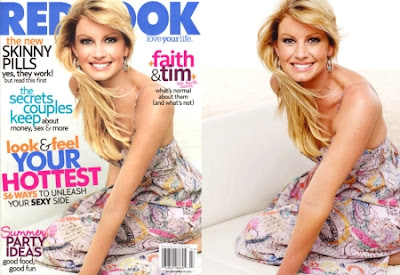
And summertime rolled right back around with this Rebook retouching job, uncovered by the intrepid ladies over at Jezebel:
It's been a strange year for retouchers. All this exposure goes against the nature of their jobs. Even the most sought-after retoucher in the world admits that he prefers to work under the radar. “I never want to talk about my work, because it's kind of taboo,'' Pascal Dangin told Kate Betts in a rare 2003 interview. "The people who benefit from my work do not benefit from me talking about it.'' True that. But in our experience, good things happen when taboos are broken. So now that the wrinkles, blemishes, and fleshy parts are out of the bag, will those images of perfection still hold the same power?
When magazine editors and advertisers defend themselves by saying that retouching is an industry standard, consumers should listen closely because they're telling the truth. Up until recently, the biggest problem with this standard was that it was so hush-hush. Thankfully, those days are over. The industry has finally been forced to fess up to the fact that, whether you agree or disagree, this is how it's done.
We talk to a lot of girls and young women in our work, and most of them have heard about retouching. Usually they envision it as something along the lines of the digital pimple zapping they might get for a high school yearbook portrait. What they don't know (and what we find most dangerous) is how frequently it's used in the media--and how extensively. If you haven't already, share everything you know about retouching with the girls in your lives. The sooner, the better.
In fashion and beauty, "aspirational" is a much-used buzz word that translates into the glossy fantasies that are just far enough out of reach to create the kind of longing that sells magazines, moisturizer, and mascara. And it's all fun and games until we start looking at these numbers: The Supergirl Dilemma, a 2006 study conducted by Girls Inc., reveals that 54% of girls in grades 3-5, 74% of girls in grades 6-8, and 76% of girls in grades 9-12 worry about their appearance.
These worries are just as intense for girls across the pond. According to a new U.K. study, 40% of 14-to-15-year-old girls admitted they don't eat breakfast and 25% of those girls also skip lunch. Over 50% of them listed their appearance as their number one concern in life.
It's time to step back from the chicken or the egg arguments for a second ("We're just responding to consumer and celebrity demands," says the industry. "We're brainwashed to crave those phony images. What we really want is more diversity," say consumers). Whatever you believe, the bottom line is that we adults can analyze, criticize, and form our own logical opinions about the issue. Meanwhile, girls are getting sucked into the perfection obsession at younger and younger ages with little understanding of the difference between fantasy and reality. Retouched images aren't entirely to blame for this crisis, but can anyone honestly deny that they play a role? Here's the question: If retouching continues to be an industry standard, how can we make sure that a responsibility to younger generations is an industry standard, too?
"Tell me what retouching is. Tell me it's why the models look so perfect. Tell me I'm amazing, not because of how I look, but because of all the things I can do. Tell me my most attractive feature is my self-confidence."
This video was created by Goodby, Silverstein & Partners for Girls Inc., the organization that inspires all girls to be strong, smart, and bold.
"A lighthearted guide to combating a silent societal epidemic...[T]he authors do a great service in bringing to light a fear that women may believe they suffer with alone...The concepts and solidarity offered here should prove valuable for millions of American women." --Publishers Weekly






 Posts
Posts





