Showing posts with label Fashion Week. Show all posts

Wednesday, February 17, 2010

The Fashion Industry Doesn't Like Coco Rocha's Grown-Up Curves

Coco Rocha is the latest model to come out against the fashion industry's stubborn adherence to a super-skinny aesthetic on the runway. Rocha has recently gone on the record saying that she has lost jobs because her body is too big now that she's reached the ripe old age of 21.

We remember when Rocha was a featured speaker at a CFDA Health Initiative forum back in 2008, where she confessed that a day in the life of a typical model involved hearing sensitive comments like, "We don't want you to be anorexic--we just want you to look like you are." She also admitted that an agent had once advised her to throw up after meals and that she had used diuretics to control her weight. Today, Rocha has a healthier outlook: “You know what, I’ve stopped caring. If I want a hamburger, I’m going to have one. No 21-year-old should be worrying about whether she fits a sample size.” The same cannot be said for many industry insiders, who, despite their attendance at the CFDA forums, are still upholding the unhealthy standard of hiring pre-pubescent girls and then routinely rejecting them when they start showing the first signs of curves.

“A lot of people are accountable, and nobody’s saying anything about it,” says James Scully a well-known fashion industry casting agent. “What happens when these girls develop and turn into women?” Well, it looks like they get the axe.

"A Model's Prospects: Slim and None" [NY Times]

Sunday, February 1, 2009

Inès de la Fressange + Velvet D'Amour: Does Jean Paul Gaultier Really Get It?

Jean Paul Gaultier sent 51-year-old model Inès de la Fressange down his runway in Paris, proving yet again that he puts his money where his mouth is when it comes to highlighting beauty that falls outside the industry standard.

Gaultier hired the the amazing Velvet D'Amour a few years ago, garnering criticism that his choice was a cynical response to the backlash against ultra-thin models. Velvet had a different take:

"JPG has been clear on the statement he was making--that beauty takes many forms... There were some who viewed my appearance as ‘farcical’, or token, but when would any appearance of a genuinely fat person NOT be viewed as such? People of size are utterly banned from any mainstream media (other then the headless, junk food munching, obese [people] witnessed on the evening news every night). There are few, if any, references of inclusion beyond ridicule."

Women of a certain age get similarly ridiculed when they try to be be taken seriously as sex symbols. Just last week, Susan Sarandon dared to wear a low-cut gown to the SAG Awards and got blasted for being age-inappropriate. What. ever. We think she looked hot, as did Inès de la Fressange, who proudly declares that she is not a workout fiend or a plastic surgery addict:

"Winston Churchill always said the best exercise is no exercise so let me put it this way; I do as much exercise as Churchill! And I never do Botox or plastic surgery either."

While we're generally not quick take beauty tips from ol' Churchill, we are officially charmed. Inès also had some pretty spot-on observations about old school vs. new school modeling:

"When I first started modeling the ambiance was like a party, it was so fun. Models like Pat Cleveland and Jerry Hall had so much energy and personality and they had fun together. The runway shows back there were much more upbeat — even in the way we walked down the runway, greeting people, turning, smiling. Now they are just told to look the same and be impersonal. I walk on the runway like I walk down the street."

Here's to beauty of all ages, colors, shapes, and sizes. Here's to fashion that's actually fun. And a very happy Monday to all of you.

Heard on the Runway: Gaultier’s 51-Year-Old Runway Star: Inès de la Fressange


Velvet D'Amour Interview Part I


Velvet D'Amour Interview Part II


51-Year-Old Model Inès de La Fressange

Friday, October 24, 2008

Are People Finally Fed Up With Model Shows? MTV Pulls the Plug on "Model Makers"

MTV began casting for a new show called Model Makers, but it appears the show will never see the light of day. That's good news, because it looked all kinds of horrible. Contestants on the show would have been forced to "endure twelve weeks of intensive physical fitness training to help them get down to their ideal size...With weekly eliminations looming, models must put their best foot forward at all times while staying focused on losing weight."

In truth, the premise of Model Makers sounds a lot closer to reality than most other model "reality" TV shows. Yes, a segment of the population of today's working models is naturally and effortlessly skinny. The rest are perpetually and sometimes dangerously focused on losing weight (remember Ali Michael?). The show's teaser line sums up exactly what's wrong with the fashion industry: "Women come in all shapes and sizes, but models don't." Actually, you could modify that line to read "Women come in all shapes, sizes, and colors, but models don't" and you would have a pretty accurate picture of what the runways at Fashion Week look like these days.

So why did Model Makers get the ax? Darryl Roberts, director of the documentary America the Beautiful, credits a massive letter writing campaign. Roberts wrote an open letter to MTV on HuffPo earlier this month. He published the casting email address and encouraged outraged readers to protest the show. We love to think of that inbox being flooded. And if MTV really did come to its senses as a result of the groundswell, that is a huge victory for woman and girlkind.

But while we're on the topic of model reality shows, we'd like to pose a question. Will audiences ever grow weary? Of course America's Next Top Model keeps on trucking into it's 200th season or something. We've also seen Model.Live, Models NYC, The Agency, She's Got the Look, 8th & Ocean, The Janice Dickinson Modeling Agency, and our personal favorite, America's Most Smartest Model. Even Project Runway insists on incorporating a model elimination within a show that's supposed to be about the designers (insert Tim Gunn inflection here). We're not exactly crying a river, or a puddle, when Heidi aufs one of them each week. Is there anyone out there shedding a tear?

We suppose there is a core audience of the model-obsessed who will watch anything and everything related to those pretty moddles. As for the rest of us, it's fun to laugh along for a while, and sometimes those shows can even be edumacational! But when does it start to get old? Is there a saturation point for eye smiling and fierceness?

[Huffington Post via Ypulse]

Tuesday, June 3, 2008

Our Interview with Velvet D'Amour: Part I

If you don't recognize Velvet D'Amour's name, you surely remember her famous walk down the runway for Jean Paul Gaultier. Velvet is an outspoken advocate for beauty diversity in the fashion industry--a job that is keeping her very busy these days. She just photographed a series of older women for the current issue of Standard magazine. She will also be shooting for an upcoming issue of PLUS Model magazine and will model for a beauty story styled by Olivier Mulin and shot by Christian Lartillot. In early July, Velvet will host a fashion extravaganza on the rooftop of London’s Alfies Antique Market. We caught up with her in Paris, the city she calls home. We're bringing you our interview in two parts. Check back tomorrow for Part Deux.

You walked the runway for Gaultier in the midst of a heated international debate about underweight models in the fashion industry. How did that collaboration come about? What kind of statement did you want to make? How did people treat you backstage?
My runway appearance for Gaultier came about as he was casting for his 30-year retrospective. I had already done runway the previous season for John Galliano, consequently, my French model agency, Contraband, sent me to the casting.

Jean Paul Gaultier had used a plus sized model back in the 80’s (and thereafter!), thus my preliminary casting was in order to appear in his retrospective. Once I made it past the initial casting, I was sent to the second casting conducted by JPG himself. He seemed very taken by the images in my book, and we had a nice chat about philosophies of beauty as well. It was wonderful to speak with such an amazing talent that I had always revered.

As to what statement I wanted to make, my quest is to diversify notions of modern beauty, and I knew my inclusion would spark debate and get people talking if nothing else. JPG has been clear on the statement he was making--that beauty takes many forms. He had also included another model from Contraband’s Master’s division, who is a senior citizen. There were some who viewed my appearance as ‘farcical’, or token, but when would any appearance of a genuinely fat person NOT be viewed as such? People of size are utterly banned from any mainstream media (other then the headless, junk food munching, obese [people] witnessed on the evening news every night). There are few, if any, references of inclusion beyond ridicule.

If people are only exposed to imagery of fat people as jokes in movies, TV, etc., then that limits our perception to degradation. So what then is the solution? Not to take the opportunity to proudly embrace my curves in a global venue? One must take advantage of these rare opportunities when presented by people who are willing to take the risk on you. I had utter confidence in both Galliano and Gaultier to represent me in a fashion inclusive of their impeccable style, and I knew their intent to be positive. I don’t think it is so ludicrous for people of such immense creativity and broadminded natures to witness beauty in what mainstream people may have blinders to.

As to backstage, it’s funny because often people seem to perceive that behind the scenes was some sort of Showgirls atmosphere, with skinny teen models spiking my Evian, or bashing on the fatty, when in fact, everyone was quite sublime. As I am both a photographer and a model, I am accustomed to being around models and thus I don’t find it an intimidating atmosphere in the least.

Whilst models are esteemed by the general public to have it all, merely by the luck of the gene-pool, (and likewise, professed to have an attitude to accompany that), they more often than not grew up equally outcast by virtue of extreme height and thinness. Thus I find models tend to be quite sympathetic and kind/curious for the most part and this certainly held true backstage at the runway shows. Its an eclectic, buzzing atmosphere.

What do you think of the term "plus-size"?
Good question. I doubt it was easy coming up with a term to encompass clothes designated for people who are purportedly larger then the current norm, in an era when being so is hardly considered popular.

I recall as a fat child having my Mom take me to the HUSKY store, and that seemed rather humiliating at the time. I had initially pictured some Alaskan dogsled hideaway, but soon found myself amidst frighteningly outdated décor, with racks of polyester knit bellbottoms in puke green, or ‘KICK ME HARD’ red, guaranteed to ensure a wedgie or two, in a era where you were nothing if you didn’t wear straight cut Levi’s.

I am sure its origins were well intentioned though, and it’s certainly better then Negative-size, ay?

Read Part II of our interview with Velvet D'Amour.

Velvet D'Amour on MySpace

Tuesday, April 1, 2008

Anna Wintour Says Models Today Are Pale, Thin, and Joyless

Anna Wintour was not impressed with the models at New York Fashion Week. "Overall, they were pale and thin and entirely lacking in the joyfulness and charm that once defined the supermodel," she writes in the April issue of Vogue. "This is, of course, not their fault: Designers now near-uniformly favor a non-vivacious, homogenous ideal." Oh, snap. And therein lies one of the central problem with tackling the fashion industry's too-skinny beauty standards. The good news is that we've gotten to the point where even the most powerful industry leaders recognize that something is awry. The bad news? Everyone thinks someone else is responsible.

Designer Bradley Bayou, whose daughter suffered from an eating disorder, is calling for a cease fire in the industry blame game. "If everybody takes responsibility and everybody works together, we can change it. In other words, the designers and the editors and the modeling agents and the models' parents and everybody gets together and decides, 'This is not a healthy thing. We must change it.' Then, hopefully, we can." We'll second that. [CBS News]

Tuesday, February 12, 2008

Model Spies Infiltrate London Fashion Week

Seven top models will act as undercover agents this week in London, filing reports on working conditions, eating disorders, and harassment issues with the actors' union Equity. One hundred models have already joined Equity in the U.K. and the union will have a drop-in office set up onsite, where models can give union officials the scoop on how they are treated during London Fashion Week. [Daily Mail]

Of course the more models are represented by a union, the greater that union's negotiating power (just look at a recent little entertainment industry scuffle and you'll see how that works ). The downside? Forming a union means risking the loss of work and facing intense pushback from the powerful businesses in the industry. Those guys are never psyched to hear the "u" word because adhering to regulations and paying standard wages and benefits affects their bottom line.

Unfortunately, convincing a majority of models to join a union is going to be an uphill battle. Today the industry is filled with very young Eastern European models, girls who are often working to support their families and are more than willing to put up with crappy working conditions for a crappy-but-better-than-nothing paycheck. It's not just a pipe dream, though. Bette Davis and Olivia de Havilland paved the way for SAG, so let's get some gutsy fashion dames together and raise hell.

Thursday, February 7, 2008

Male Models are Feeling the Skinny Pressure, Too


Fashion PR spin says male models are getting skinnier because of consumer demand for that look (yeah, right) while casting agents point to Hedi Slimane (nope, the last name is not lost on us), former head of Dior Homme, who is credited with setting the scrawny chic dude trend in motion. There are theories o' plenty, but not too many definitive answers--and even fewer proposed solutions. As has been the case from the beginning of the discussions about the unhealthy size of models, this is a classic game of responsibility hot potato. But the bottom line is that men on the runways are shrinking.

Demián Tkach is a 26-year-old model who said that when he came here from Mexico, where he had been working: “My agency asked me to lose some muscle. I lost a little bit to help them, because I understand the designers are not looking for a male image anymore. They’re looking for some kind of androgyne.” [New York Times]

Friday, February 1, 2008

The First Day of Fashion Week Also Marks the First Day of Black History Month

People are talking about the lack of ethnic diversity among the models on the runways, but did you know that Tracy Reese is the only black designer to show inside the Bryant Park tents this week?

In other fashion diversity news, casting director Jennifer Venditti was interviewed for the Wall Street Journal, recounting an incident when a client's stylist insisted that she didn't need to hire a second black model because they already had one. Venditti told her "They're both beautiful. Why can't you have two?" As for whether the industry is open to lasting change, Venditti offered her real opinion on the matter. "In general, [the industry] is a bunch of followers," she says. But "the conversation has started."

Fashion Week Day 1: Remember The CFDA Guidelines, Designers?

Almost exactly a year ago, the CFDA hosted a breakfast to announce their Health Initiative. It was a bitter cold morning but the fashionistas bundled up and turned out in droves to hear the announcement of the CFDA's recommendations to promote wellness and a healthier working environment for models. Lest we forget, here are those recommendations:

1. Educate the industry to identify the early warning signs in an individual at risk of developing an eating disorder.

2. Models who are identified as having an eating disorder should be required to seek professional help in order to continue modeling. And models who are receiving professional help for an eating should not continue modeling without that professional's approval.

3. Develop workshops for the industry (including models and their families) on the nature of eating disorders, how they arise, how we identify and treat them, and complications if they are untreated.

4. Support the well-being of younger individuals by not hiring models under the age of sixteen for runway shows; not allowing models under the age of eighteen to work past midnight at fittings or shoots; and providing regular breaks and rest.

5. Supply healthy meals, snacks, and water backstage and at shoots and provide nutrition and fitness education.

6. Promote a healthy backstage environment by raising awareness of the impact of smoking and tobacco-related disease among women, ensuring a smoke-free environment, and address the issue of underage drinking by prohibiting alcohol.

The CFDA has taken a lot of heat for not including BMI restrictions in their guidelines. However, we think there's an even more important recommendation that's missing: medical exams for models. In fact, the medical experts and fashion industry insiders we surveyed agreed that exams were most likely to be effective.

A low BMI might signify an eating disorder, but an average BMI certainly doesn't mean that a model is in good health. People with eating disorders are not always dangerously underweight. Magali was never stick thin, but she was so sick that she once passed out at a photo shoot. If we're serious about protecting models' health, we need to find a way to ensure that they are getting regular check-ups. A doctor can examine the physical, but perhaps more important is that private one-on-one time when a trained professional can ask each model how she/he is doing emotionally. It's a question that's rarely asked in such a frantically-paced industry where young models are increasingly replaceable. It's a question that can be a lifesaver.

Thursday, January 31, 2008

Fashion Week Has Issues... And That's Good News

New York Fashion Week kicks off tomorrow amid serious conversations about diversity of size, shape, and ethnicity on the runway. The buzz word is "change." And while that trend might be slow to take off, it's certainly one we're committed to following for the long haul.

CFDA Health Initiative Chair Nian Fish tells us that CFDA President Diane Von Furstenberg sent out a letter in advance of the New York shows reminding designers to follow the guidelines set out last year.

Three industry forums
have been held in New York to discuss the lack of models of color on the runway.

Newly-appointed Chairman of the British Fashion Council Harold Tillman intends to enforce strict adherence to the Model Health Inquiry's recommendations. "If the British Fashion Council weren't doing something about it I wouldn't have joined," he told The Evening Standard. London Fashion Week starts February 10th. [British Vogue]

"Real people models"
are turning up in ads and on runways in other cities. Will we see any during New York Fashion Week? Time will tell. [Newsweek]

Wednesday, January 30, 2008

Model Mentors

Runways are filled with girls modeling clothes meant for women. Behind the scenes, these young models' careers depend on their ability to behave with savvy and sophistication well beyond their years. Their physical and emotional health depends on whether they can manage to stay grounded in an industry built on fantasy. Veteran models who have been there, done that, and lived to tell about it could have a lot of guidance to offer these girls. That's why the British Fashion Council's newly appointed chairman Harold Tillman is advocating for model mentoring.

"These are women that younger models admire," he said. "We should get these original supermodels on board and get them more involved." Tillman is also serious about adhering to the guidelines developed by the Model Health Inquiry. "Many girls are looking after themselves but there is unfortunately a minority that isn't. We need the rest of Europe and the rest of the world on board." [British Vogue]

Friday, January 25, 2008

Diversity and Responsibility in Fashion

With NYC Fashion Week fast approaching, agency owner Bethann Hardison hosted a forum this week to discuss the absence of models of color on the runways and in the pages of fashion magazines. This was the third event in a series she launched in September.

The topic is an important one, and we were especially pleased to see that some of the most vocal contributors to this conversation have also been leaders when it comes to addressing the issue of eating disorders and other health issues affecting the industry. Nian Fish of KCD, who chairs the CFDA Health Initiative (and who we interviewed about her role) and creative director James Scully, who has been a strong proponent of eating disorders education and awareness, both spoke at this week's forum. Their leadership is evident in their ongoing willingness to take responsibility, start tough conversations and to speak the truth about their own experiences in order to bring about positive changes.

In a message he wrote for the diversity forum, Vogue editor-at-large Andre Leon Talley expanded on the Obama slogan (he is currently volunteering for the campaign) to say "change we can believe in has to happen." We'll second that.

For more coverage, check out Jezebel.

Thursday, December 13, 2007

Will Models Unionize?

The Independent is reporting that a group of successful models in the U.K. is trying to join the Equity union, which represents actors and performers. "Models have no voice; no one is listening to them and no one is asking them what they want," said Martin Brown, an Equity spokesman who has been involved in the negotiations with the models since the spring. Spot on! He said: "We were approached earlier this year by a group of models who said they needed a union. They complained they had no one to represent them and that if something went wrong and they went to their agencies they were warned not to complain because they would not work again."

As I wrote about during New York Fashion Week, a union is exactly the kind of shake-up that needs to happen in the industry, and it's probably the only thing that will result in real rights and protections. Models (most of whom are very young and eager to please) face harsh working conditions and unhealthy pressures within a system where there is zero accountability. A union could change that--if enough models were willing to take the risk and join. We are working to organize a meeting in the U.S. If you're interested in getting involved, please get in touch. There is strength in numbers!

Friday, September 28, 2007

Why is No-l-ita Offering No-Information for Sufferers?

After all this talk about the "No Anorexia" campaign, I decided to show you a picture of another nude model--me.

This is from a 1999 article in Glamour, when I first went public about my seven-year battle with bulimia. I was healthy when the photo was taken, but my body didn't look much different from when I was very sick. That's the thing about eating disorders. They don't always look so shocking.

I have a lot of mixed feelings about the No-l-ita ad campaign. First, it is of no surprise to me that the campaign comes from Oliviero Toscani. After all his years at Benetton, he has become known for this style. I think he is a great artist in his ability to increase the visibility of taboo topics. He has certainly gotten people talking with this uncomfortable, extreme image of a very sick anorexic. After Ana Carolina Reston's death last year and the declarations and recommendations of fashion councils around the world, I am glad to see the discussion continue. However, it saddens me to see that, yet again, the focus is on the extreme. Yes, sensationalism works and gets people's attention, but it's such a limited view of what eating disorders look like. I appeared on a few billboards when I was so ill and depressed I thought I would die. That desperation never showed up in the pictures, though.

Finally, publicity for the sake of it is, in my mind, very selfish, irresponsible and money-oriented. When I came out and talked publicly about my eating disorder, I didn't just want to put myself in the spotlight--I wanted to make sure that my story helped and served a purpose. That's why I searched for an organization that worked to raise awareness and helped people deal and get treatment. Whenever I talk about my own experience, I make sure that there are resources available for anyone who needs help. Since No-l-ita is taking on eating disorders as the face of their campaign, it would be thoughtful for them to give eating disorder resources on their website. When you see that billboard, what next? How about providing some information on the issue they're using to get attention? Controversy gets people buzzing. But let's make sure this is not a case of all talk and no action.

Note: We have written to No-l-ita, suggesting that they include health and referral information as part of their campaign. We have not received a response yet, but will keep you updated.

Related:
Fashion Statement: Oliviero Toscani
Has the "No Anorexia" Ad Become Pro-Ana Thinspiration?

Photo: Michael O'Neil

Monday, September 24, 2007

Fashion Statement: Oliviero Toscani

Fashion photographer Oliviero Toscani is not one to shy away from controversy or shock tactics. Now he is taking on the anorexia epidemic in a new ad campaign picturing an emaciated anorexic with the tagline "No anorexia." The ad is sponsored by Italian clothing company No-l-ita and will be featured on billboards in many Italian cities--just in time for Milan Fashion Week. "I've been looking at the problem of anorexia for years. Who is responsible? Communication in general? Television? Fashion?" asked Toscano.

"So it is very interesting that in the end a fashion company has understood the importance of the problem, and with full awareness has found the courage to take the risk this campaign involves," he said in a No-l-ita press release.

While we don't think the media and the fashion industry are entirely responsible for causing anorexia, we are completely on board with the idea that they should take responsibility for promoting healthier images of beauty. The images in this ad clearly show what un-retouched anorexia looks like. No makeup. No designer clothes. No forgiving lighting. It's not pretty.

Toscani raises another important point, though. The industry does need to be aware of the gravity of anorexia. But what about other eating disorders? Public education campaigns (and celebrity tabloids for that matter) have long relied on the image of the emaciated anorexic because it is the most startling and visible of eating disorders. However, most sufferers do not wear their illnesses as skin and bones. Millions of people are caught up in dangerous, life-threatening eating disordered behavior. You wouldn't stop in your tracks if you saw their pictures on a billboard because they don't look skeletal. You wouldn't gasp or speculate about their health because they have pretty "normal" bodies. Too-skinny model spotting has practically become a media pastime, but there are plenty of curvier runway regulars who are suffering, too. [Reuters and AFP]

Related:
Has the New "No Anorexia" Ad Become Pro-Ana Thinspiration?
Why is No-l-ita Offering No-Information for Sufferers?

Monday, September 17, 2007

Tween Runway Queen

12-year-old Maddison Gabriel was selected as the official ambassador of Gold Coast Fashion Week in Australia, a decision that does not sit well with Aussie Prime Minister John Howard. "There should be age limits, I mean...we do have to preserve some notion of innocence in our society," he said. Many in the fashion industry would actually agree with him--age recommendations have been made and enforced in both Europe and the U.S. (although girls are still no strangers to the runways.)

What does lil Maddison have to say about the controversy? "I believe that I can fit into women's clothes. I can model women's clothes, so I should be able to do it." Her mom, for the record, is of the opinion that "[The Prime Minister] does not know exactly what 13 and 14-year-old girls are like. I used to vote for him. We're trying to get our teenage daughters to act older. I am so happy that I've got a daughter who has got a good head on her shoulders." Yeah, except that your daughter is 12. Last time we checked that number comes before 13 and 14. [Daily Mail]

UPDATE: Happy Birthday, Maddison! She just celebrated the big 1-3, so I guess we should let her mom off the hook now that she's officially a mature teenager prepared to deal with all the insane pressures of the fashion industry. Riiight.

Monday, September 10, 2007

Teen Model Shops at Forever 21. OMG!

Chanel Iman is fashion's It Girl (good thing she ended up with the bone structure to go with that name). But in between walking runways for Diane von Furstenberg, Marc Jacobs and Dolce & Gabbana and shooting spreads for Vogue, you might find 16-year-old Chanel hunting for bargains at Forever 21 or chowing down at Roscoe's with her L.A. pals. Believe it or not, this top model acts her age when she's not on the fashion clock. Oh, and she's already been working steadily for three years.

In fact, a large percentage of the world's top models started their careers well before they could vote or even drive. It's sometimes hard to tell, though, when we see them all made up and decked out in couture. So what does Chanel think about the debate over runway models being too skinny? "I eat everything," she says. "People don't realize that we're so young. These models are coming in when they're like 13 or 14 years old. We're wearing women's clothes, but we're actually not developed yet." [LA Times]

photo: Kirk McCoy/LAT

Thursday, September 6, 2007

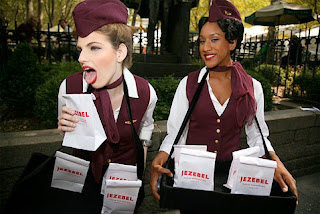
Fashion Statement: Jezebel


We've developed quite the girl crush on the Jezebel gals. Today we were practically swooning after we got a look at these two airline hostesses who showed up at at the Bryant Park tents to offer the "fashion weak" some good old-fashioned barf bags filled with Ex-Lax, tongue depressors, and tic tacs. Bulimia jokes don't usually make us laugh, but let's give credit where credit is due. This is an inspired stunt, complete with a catchy tagline: Fashion Week Make You Want to Hurl? We're Here to Help. Bonus: watch the video.

And for the record, if Fashion Week really does make you want to hurl, please get your help from a professional. Check out the column to your left and you'll find lots of resources.

Model/Actress Ponderings

Are you familiar with the snark-inspiring "model/actress" label? Well, I belong to that club. Guilty as charged. But in defense of all the other M/As out there, the benefits and protections afforded to actors make that SAG card look pretty darn appealing, especially since there's nothing that even remotely resembles a union for models.

We launched the 5 Resolutions network after Brazilian model Ana Carolina Reston died from anorexia. As we started to connect with others in the industry, I started seriously pondering the state of models' working conditions. We released the findings from our latest survey, and I kept on pondering--mostly about my own journey from model to M/A.

I've been working as a model for my entire adult life. When I joined the Screen Actors Guild in 1994, I suddenly discovered this whole new world where workers had rights (gasp!) and companies had to follow rules (incredible!). There's a framework in place in Hollywood. It just hasn't quite made it to the fashion capital. Yet. The way I see it, models deserve benefits and protections, too. We should start demanding them.

Sure, models are financially compensated for our work. Some of us are paid very well. But even the most successful supermodels in the world (and they're a dying breed, according to Claudia Schiffer) don't come anywhere near the $70 million an actor like, say, Tom Cruise makes on the job. The truth is that most models are underage and underpaid.

SAG members get pensions and health plans that include medical, dental, vision, prescriptions, and mental health coverage (okay, so Tom is not exactly taking advantage of that one). To claim these benefits, we pay a premium (about $150 a quarter) and our dues–$116 a year plus a small sliding scale percentage based on our earnings. There's also a hotline, which members can call if they have questions about their rights, their health, or to report an unsafe work environment. Before I joined SAG, I had to fend for myself where health insurance and retirement savings were concerned. And there's no model 411, I can tell you that much.

Every time I start a movie, I have to make an appointment with a doctor, who assesses my physical ability and mental stability to do the job. While our survey shows that health and fashion professionals agree that yearly exams would be the most effective way to protect the health of models, it isn't happening because there's no organization to manage it.

As an actor, I get my own private changing room. Has anybody ever provided private changing rooms backstage at any fashion show? I remember changing in rooms with a hundred other people, rushing to cover up and avoid having the photographers' cameras invade my privacy.

When I shoot a movie or TV scene where characters are drinking, no actor is REALLY drinking anything alcoholic (though some of them might wish they were). There is no booze served on the set. How many bottles of champagne are emptied on a regular basis at fashion shows? Want to earn some extra cash from recycling? Just hang outside the Bryant Park tents and wait for the Dom Perignon bottles to pile up. Trade 'em in and you'll make a killing.

For acting jobs, I get a mandated twelve hours of rest between the time I finish work until my call time in the morning. Sounds pretty reasonable, but it's an extravagant luxury compared to midnight fittings when your first fashion show wants you there at 8 a.m. Or try flying into a city, landing at 2 a.m. and your call time is 6 a.m.

In 1933, SAG was founded by an "action-oriented, motivated, gutsy" group of actors who risked their careers because they were fed up with unfavorable working conditions and grueling hours. Hmmm, sound familiar? As much as I love fashion, I don't think there is anyone who would disagree that the industry has its own share of unfavorable working conditions and grueling hours. So what are we going to do about it?

Models march down runways for a living. What would happen if we marched for our rights? I'll admit it's a ridiculous image, but I'd be willing to bet that with enough of the old guard on board we could make some real changes for the young models who are slaving away on runways today. And we could probably manage to do it without falling on our faces. Any action-oriented, motivated, and/or gutsy takers out there? Post your ideas or email us. 5resolutions[at]insidebeauty[dot]org

Tuesday, September 4, 2007

9 out of 10 Doctors and Fashionistas Agree...

According to our survey, both fashion and health professionals rated yearly exams including eating disorders assessments as the most effective way to protect the health of models.

Remember last New York Fashion Week when the CFDA Health Initiative panel discussion was the hottest event in the tents? There is less buzz about the too-skinnies this season (maybe because some of them couldn't get work visas?), but we want to make sure this issue doesn't slip off the radar.

To keep the discussions moving forward, we conducted an online survey and asked our fashion and health colleagues this question: "What do you think about the following recommendations that have been proposed to protect the health of models?" We got 234 responses from a sample that included models, agents, designers, editors, writers, creative directors, hair stylists, makeup artists, photographers, publishers, publicists, medical doctors, eating disorder experts, nutritionists, and mental health professionals. Here's how the two groups rated the various recommendations:

Fashion and Beauty Professionals
1. Yearly exams including eating disorder assessments for models
(66% said "likely to be effective"; 22% said "might be effective")

2. Require models identified as having eating disorders to seek professional help*
(59% said likely to be effective; 34% said might be effective)

3. Weight/body mass index guidelines for models
(54% said likely to be effective; 20% said might be effective)

4. Industry-wide education and awareness programs*
(51% said likely to be effective; 37% said might be effective)

5. Age guidelines for models*
(42% said likely to be effective; 32% said might be effective)

6. Regular breaks and rest for models
(42% said likely to be effective; 29% said might be effective)

7. Healthy food and snacks at fashion shows*
(32% said likely to be effective; 37% said might be effective)

8. Ban on smoking at fashion shows*
(49% said unlikely to be effective; 22% said might be effective)

9. Ban on alcohol at fashion shows*
(54% said unlikely to be effective; 29% said might be effective)


Health Professionals

1. Yearly exams including eating disorder assessments for models
(62% said "likely to be effective"; 28% said "might be effective")

2. Weight/body mass index guidelines for models
(55% said likely to be effective; 40% said might be effective)

3. Industry-wide education and awareness programs*
(55% said likely to be effective; 34% said might be effective)

4. Require models identified as having eating disorders to seek professional help*
(50% said likely to be effective; 42% said might be effective)

5. Age guidelines for models*
(40% said likely to be effective; 42% said might be effective)

6. Regular breaks and rest for models
(37% said likely to be effective; 47% said might be effective)

7. Ban on smoking at fashion shows*
(37% said likely to be effective; 33% said might be effective)

8. Healthy food and snacks at fashion shows*
(25% said likely to be effective; 43% said might be effective)

9. Ban on alcohol at fashion shows*
(38% said might be effective; 33% said unlikely to be effective)

*included in the CFDA Health Initiative Guidelines

If annual check-ups and eating disorder screenings got the highest marks all around, why aren't models required to get a clean bill of health before working? Mandatory health exams are not unheard of in other industries, but the larger-than-sample-sized elephant on the runway here is the question of how these exams would be regulated and paid for when there is no structure of accountability or union to protect the fashion worker bees. Yep, we said the "u" word.

And speaking of unions, Magali happens to be a member of one you might have heard of. It's called SAG. Here is her model/actress comparison of working conditions, rights, regulations, and benefits in the fashion and film worlds.